Obesity and Bariatric Surgery
Obesity
Obesity is not a simple condition of eating too much. It is now recognized that obesity is a serious, chronic disease. Obesity was widely perceived as a symbol of wealth and fertility at other times in history, and still is in some parts of the world. In 2013, the American Medical Association classified obesity as a disease which leads to many comorbidities like diabetes, high BP (hypertension), cholesterol, infertility, PCOS (PCOD), arthritis, sleep apnea etc. Obesity is a leading preventable cause of death worldwide, with change in lifestyle there is increasing prevalence in adults and children, and authorities view it as one of the most serious public health problems of the 21st century.
Causes of Obesity
Here’s a very simple explanation of how you put on weight and will lose weight with surgery. Your body needs energy to function and your energy source is the food that you eat. A normal weight person successfully balances their energy intake (food eaten) with their energy requirements (daily activity). In other words, they burn up all the energy provided by the food they eat, and stay slim. At an individual level, change in lifestyle i.e. combination of excessive food energy intake and a lack of physical activity is thought to explain most cases of obesity. A limited number of cases are due primarily to genetics, medical reasons, or psychiatric illness. In contrast, increasing rates of obesity at a societal level are felt to be due to an easily accessible and palatable diet, increased reliance on cars, and mechanized manufacturing.
Consequences of Obesity or Why Treat Obesity
The costs linked with treating obesity and its related health conditions are enormous. Putting the costs aside, the main concern regarding obesity is the impact it has on health. Almost all body systems are affected by obesity. Being overweight can also shorten your life. On average obese people are likely to die 10 years earlier than those who are not overweight, preventing many from reaching retirement age. The heavier you are and the longer you have been overweight the greater the risk
If you are obese, severely obese, or morbidly obese, you may have major health risks.


Specialties
-
Shorter Life Expectancy
-
Diabetes (type 2)
-
High Blood Pressure
-
High Cholesterol
-
Joint problems (e.g., arthritis)
-
Obstructive Sleep Apnoea
-
Heart disease
-
Gallbladder problems
-
Certain types of cancer (breast, uterine, colon)
-
Digestive disorders (e.g., gastroesophageal reflux disease, or GORD)
-
Breathing difficulties (e.g., sleep apnea, asthma)
-
Psychological problems such as depression
-
Problems with fertility and pregnancy (Polycystic Ovary Disease PCOD)
-
Incontinence
What is obesity or bariatric surgery?
Bariatric surgery, also known as weight loss surgery, refers to the operations designed to reduce weight (bariatric come from the Greek meaning pressure or weight). Operations may restrict the amount you are able to eat (restrictive operations such as the gastric band sleeve gastrectomy) or both restrict the amount you can eat and reduce the amount you can absorb (gastric bypass, mini gastric bypass or duodenal switch). The term does not include procedures for surgical removal of body fat such as liposuction or abdominoplasty (tummy tuck).
Why do Bariatric Surgery?
There can therefore be many benefits to health with weight loss, particularly after obesity surgery. Scientific research demonstrated that obesity surgery can reduce health problems considerably, as shown in the table below:
One study, conducted in Sweden, demonstrated quite clearly the differences in health between a group of obese patients who underwent surgery and those that did not.
Types of Bariatric surgery
We at Obesity Care offer wide range of surgical procedures such as gastric banding, Roux-en-Y bypass (gastric bypass), sleeve gastrectomy and Gastric Balloon. All operations are performed laparoscopically (keyhole surgery), which will help you to get up and around and back to normal as soon as possible after surgery. One of the mainstays of our service is the multidisciplinary team. Each team member has his or her own role and all together we ensure you are fully informed about weight loss surgery and that your operation is performed in the safest possible environment. Your safety is our first priority.
How surgery works?
Obesity surgery works by helping to reduce the number of calories that are available in your body. There are two ways this can be achieved surgically:
• Restriction – by reducing the size of the stomach, only small meals can be eaten and the appetite is satisfied
• Malabsorption – by bypassing part of the small intestine, less calories from food are absorbed by the body
 In this procedure, the surgeon creates a narrow tube-like stomach and removes the remainder. Hence, the capacity of the new stomach is much smaller than the original. It is usual to offer this operation as a first stage procedure to super obese patients – a second stage procedure is then offered after the patient has lost some of the excess weight to make this type of surgery safer. In a small number of patients, a sleeve gastrectomy may be the only operation that is required. It should be noted however, that long-term data of weight loss following sleeve gastrectomy is not yet available. In this procedure, the surgeon creates a narrow tube-like stomach and removes the remainder. Hence, the capacity of the new stomach is much smaller than the original. It is usual to offer this operation as a first stage procedure to super obese patients – a second stage procedure is then offered after the patient has lost some of the excess weight to make this type of surgery safer. In a small number of patients, a sleeve gastrectomy may be the only operation that is required. It should be noted however, that long-term data of weight loss following sleeve gastrectomy is not yet available.
Advantages:
-
You can expect to lose roughly 50-60 per cent of your excess weight.
-
The amount of food that can be consumed at a meal is restricted.
-
Food passes through the digestive tract in the usual order, allowing it to be absorbed fully by the body.
-
There is no re-routing of small intestines
Welcome to Obesity Surgery Unit at DMH.
-
We appreciate how difficult it is to loose weight and maintain it.
-
Many of you must have tried various means to loose weight with limited success.
-
Our dedicated team will be able to guide you.
OBESITY – THE PROBLEM
-
India ranks amongst top 10 obese nations of the world.
-
1.20 Crore Indians living in cities are obese.
-
Urban India
-
12.7% Females obese
-
9.7 % Males obese
-
Maharashtra
-
17.7% Females obese
-
12.7% Males obese
OBESITY IS CAUSED BY LONG - TERM POSITIVE ENERGY BALANCE

CAUSES OF OBESITY
-
Excessive energy (Food) intake.
-
Easily accessible and palatable diet.
-
Processed and ready made food.
-
Lack of exercise.
-
Sedentary lifestyle.
-
Increased reliance on cars.
-
Mechanized manufacturing.
Causes of Obesity - Diet
Our eating habits have changed: Food tends to be rich.
Diet- Migrant Workers
Dietary habits change in migrant workers.
Diet- Children
Change in after school diet in children.
Easily Accessible & Palatable Diet
Lack of Exercise - School Children
Change of lifestyle in school children.
Increased Reliance On Cars
HOW TO CALCULATE OBESITY - BMI CHART
Body Mass Index = Weight in kg/ height in mt2
CLINICAL PARAMETERS OF ASSESSING OBESITY
Apart from BMI, other risk factors Include:
-
High triglycerides (TG).
-
Low High Density Lipoproteins (HDL).
-
High Blood Pressure (BP).
-
Fasting Blood Glucose.
-
Increased waist circumference.
Obesity - Complications
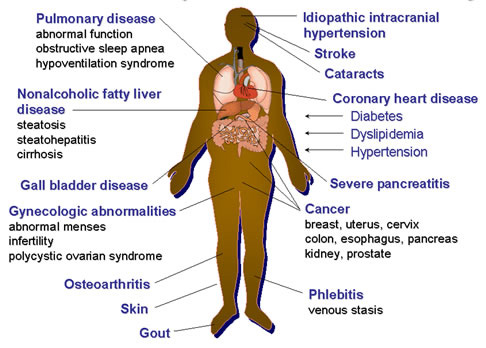
Diabetes- Complications

Obesity - Consequences
If you are obese you are:
-
3.8 times more likely to develop diabetes.
-
5.6 times more likely to develop high blood pressure.
-
2 times as likely to develop arthritis.
-
More likely to be infertile.
-
More likely to snore and suffer sleep disorders.
-
6 times more likely to develop gallbladder disease.
-
More likely to have a stroke.
-
More likely to suffer back problems.
-
More likely to suffer depression.
-
Every 10 kg above stipulated weight decrease life by 3 years.
-
Overweight or obese at 40 yrs – life expectancy 4-6 years.
-
Morbid obesity – reduces life by 10 years.
WHY LOOSE WEIGHT
Health Improvement
-
Feel Better.
-
Less aches and pains.
-
More physically mobile.
-
Increased Longevity.
-
Less medications needed.
More energy for enjoyable activities
-
Family recreation.
-
Personal Hobbies.
-
Physical activities.
-
Social events.
OBESITY - TREATMENT
-
Lifestyle Modifications.
-
Pharmacological treatment.
-
Surgery.
MOTIVATION FOR LOSING WEIGHT
Improved self-image and self esteem gives:
-
More confidence in social situations.
-
Expands employment opportunities and professional growth.
-
Improves family relationships.
WHY DO BARIATRIC SURGERY?
-
Results greater than Weight Loss than diet and exercise.
-
Weight loss maintained for more than 10 yrs.
-
Reduction in co-morbidities e.g. diabetes, high blood pressure, high cholesterol.
-
Improvement in Quality of Life
SURGERY- AM I ELIGIBLE?
-
BMI greater than 37.5 (Approx. above 95 kg) or
-
BMI greater than 32.5 in association with medical complications of obesity (e.g. cardiovascular disease, type 2 diabetes, sleep apnea, PCOD, high blood pressure)
BARIATRIC SURGERY- HOW IT WORKS?
-
Reduce appetite, induce satiety.
-
Alter the taste of food.
-
Restrict intake.
-
Change in absorption of food.
-
Increase energy expenditure.
BARIATRIC SURGERY- HOW IT WORKS?
Sleeve Gastrectomy (SG):
-
Restrictive
-
Early satiation.

BARIATRIC SURGERY- HOW IT WORKS?
Gastric By pass (GBP or RNY)
:
(Restrictive and Malabsorbtive)

BARIATRIC (OBESITY) - SURGERY- BENEFITS

IS OBESITY SURGERY SAFE?
-
These surgical procedures are very safe and complication rates are as low as any other surgery.
-
Advanced techniques like laparoscopic or keyhole surgery have made it safer.
PREPARATION FOR SURGERY
-
Each patient is individually assessed in our obesity clinic.
-
All surgical options are discussed with the patient.
-
Type of surgery will depend on medical conditions and of course your choice.
-
Pre-op evaluation (investigations).
-
Dietetic assessment.
HOSPITAL STAY
-
Day one in ICU.
-
Gradual recovery.
-
Discharge to home in 4-5 days.
-
Normal routine 10 days.
DIET AFTER OPERATION
-
Special diet for 4-5 weeks.
-
Normal diet after 5-6 weeks.
-
Under dietician control.
MEDICINES & FOLLOW UP
-
Multivitamin tablets.
-
Vitamin- D tablets.
-
Vitamin B-12 injection.
-
High BP/ Diabetes tablets.
-
Regular follow up for 2 years.
WHY CHOOSE MANGESHKAR OBESITY SURGICAL SERVICES
-
Comprehensive care by a dedicated team having insights into specific problems of morbidly obese patients, all under one roof.
-
Specially trained doctors.
-
Focus on complete solution, not just surgery.
-
Team comprises bariatric surgeon, anaesthesiologist, Intensivist, nutritionist, endocrinologist and physiotherapist
KNOW YOUR SURGEON
|